


Most professionals have heard of DMAIC. Very few know how to actually run one from start to finish. This guide fixes that — phase by phase, tool by tool, with examples from Indian industries so you can see exactly how it works in practice.
Key Takeaways
- DMAIC stands for Define, Measure, Analyze, Improve, Control — the core problem-solving framework of Lean Six Sigma
- Each phase has specific tools and deliverables — skipping phases is the most common reason projects fail
- DMAIC works in every Indian industry — manufacturing, IT, pharma, BFSI, and healthcare
- A single well-executed DMAIC project in India typically delivers Rs.10L to Rs.2Cr in documented savings
- Green Belt certification teaches you to lead a full DMAIC project independently
What Is DMAIC and Why Does It Matter?
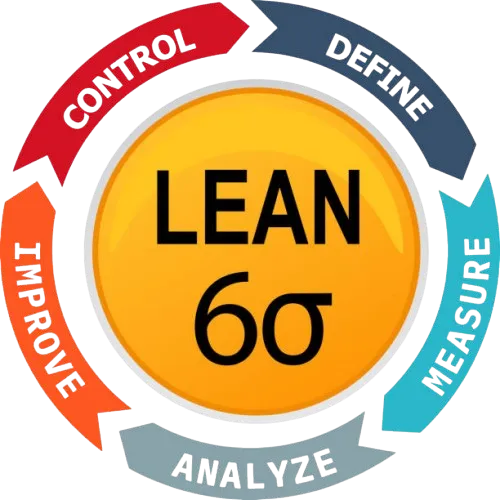
DMAIC is a data-driven problem-solving framework used in Lean Six Sigma. It stands for Define, Measure, Analyze, Improve, and Control. It is not a theory — it is a structured sequence of steps that takes a business problem from vague complaint to permanent solution.
What makes DMAIC different from regular problem-solving is that every decision is backed by data, every solution is tested before full implementation, and every improvement is locked in with controls so the problem cannot come back.
In India, DMAIC is being applied in Tata Motors plants, Infosys delivery centers, Sun Pharma facilities, HDFC Bank operations, and Apollo Hospitals — any place where a process repeats and quality matters. If your work involves a repeated process, DMAIC applies to you.
Phase 1 — Define: What Problem Are We Solving?
The Define phase answers one question: what exactly is the problem, and why does it matter? This sounds obvious but most teams skip it and pay the price later when they realize they solved the wrong problem.
Key Tools in Define
Project Charter: A one-page document that defines the problem statement, goal, scope, team, and timeline. It is the contract between the project team and leadership. Without it, scope creep kills the project.
Voice of the Customer (VOC): Structured interviews, surveys, or complaint data that tells you what the customer actually experiences. In a pharma company in Hyderabad this might mean interviewing internal QA teams about documentation delays. In a Bengaluru IT firm it might mean analyzing SLA breach tickets.
SIPOC Diagram: A high-level map of Suppliers, Inputs, Process, Outputs, and Customers. It gives the whole team a common view of the process before diving into details.
India Example — Define Phase
A Chennai auto parts manufacturer was losing customers due to late deliveries. The Define phase produced a project charter with this problem statement: "On-time delivery rate is 71% against a customer requirement of 95%, causing Rs.8L in monthly penalties." That specific, measurable statement focused the entire team for the next 4 months.
Phase 2 — Measure: What Does the Data Actually Show?
The Measure phase establishes the current state with hard data. Opinions are replaced with facts. You measure the process, collect baseline data, and calculate how bad the problem actually is before you touch anything.
Key Tools in Measure
Process Mapping: A detailed flowchart of every step in the process as it actually happens — not as it is supposed to happen. The gap between the two is usually where the problem lives.
Data Collection Plan: A structured plan for what data to collect, how, from where, and how often. Without this, teams collect the wrong data and waste weeks.
Measurement System Analysis (MSA): Verifies that your measurement method is reliable. If your measuring instrument or process is inconsistent, your data is garbage — and you will make wrong decisions based on it.
Process Capability (Cp, Cpk): A statistical measure of how well your process performs against customer specifications. A Cpk below 1.0 means you are regularly producing defects.
India Example — Measure Phase
The Chennai manufacturer mapped their delivery process and discovered 14 handoff points from production completion to truck dispatch. Data showed the average delay was 3.2 days — 80% of which occurred at just 2 of those 14 handoffs. That insight was only possible because they measured every step.
Phase 3 — Analyze: What Is Actually Causing This?
The Analyze phase finds the root cause — not the symptom. This is where most teams without Lean Six Sigma training fail. They jump to solutions before understanding causes, fix the wrong thing, and the problem comes back within weeks.
Key Tools in Analyze
Ishikawa Diagram (Fishbone): A structured brainstorming tool that maps potential causes across 6 categories — Man, Machine, Method, Material, Measurement, Environment. It prevents the team from fixating on one cause too early.
5 Whys: Ask "why" five times in sequence until you reach the root cause. A machine breaks down — why? Maintenance was skipped — why? No schedule existed — why? No one owned it — that is the root cause.
Hypothesis Testing: Statistical tests that confirm whether a suspected cause actually has a significant relationship with the defect. Used in Green Belt and Black Belt projects to remove guesswork from root cause identification.
Pareto Chart: Shows which causes account for 80% of the problem — based on the Pareto principle. Focus your fix on the vital few, not the trivial many.
India Example — Analyze Phase
The fishbone analysis revealed 11 potential causes for the delivery delays. A Pareto chart showed that 78% of all delays came from two causes: manual invoice approval taking 18 hours on average, and a shared transport booking system with no priority logic. The team now had precise targets.
Phase 4 — Improve: Fix It and Test It
The Improve phase designs and tests solutions targeted at the root causes confirmed in Analyze. Critically — solutions are piloted before full rollout. This prevents the classic mistake of implementing an expensive solution that does not actually work at scale.
Key Tools in Improve
Solution Matrix: Evaluates potential solutions against criteria like cost, impact, time to implement, and risk. Removes politics and gut feel from solution selection.
Pilot Testing: Run the solution on a small scale first — one shift, one line, one department. Measure results. Adjust. Then scale.
Design of Experiments (DOE): A statistical method to test multiple variables simultaneously to find the optimal combination of settings. Used extensively in manufacturing and pharma.
Future State Value Stream Map: A redesigned process map showing exactly how the improved process will flow with waste removed.
India Example — Improve Phase
Two solutions were piloted: a digital invoice approval workflow replacing the manual 18-hour process, and a priority-coded transport booking system. After a 3-week pilot, invoice approval time dropped from 18 hours to 45 minutes. On-time delivery improved from 71% to 91% during the pilot period alone.
Phase 5 — Control: Make Sure It Stays Fixed
The Control phase is what separates Lean Six Sigma from every other improvement method. Without it, processes drift back to their old ways within 3-6 months. Control embeds the improvement into the system so it holds even after the project team moves on.
Key Tools in Control
Control Chart (SPC Chart): A real-time graph that monitors the process and signals when it is drifting out of control — before a defect is produced. The most powerful ongoing quality tool in Lean Six Sigma.
Control Plan: A document that specifies what to monitor, how often, what the acceptable range is, and exactly what to do if the process goes out of range. Anyone can run the process correctly using this plan.
Standard Operating Procedures (SOPs): Updated process documents that capture the new way of working. The old SOPs are replaced — so people cannot revert to old habits.
Handover and Sign-Off: Formal transition of the improved process to the process owner with documented results and ongoing monitoring responsibilities.
India Example — Control Phase
A control chart was set up to monitor daily on-time delivery rate with an alert trigger below 90%. A control plan was handed to the logistics manager with clear escalation steps. Six months after project closure the on-time delivery rate was holding at 94% — and the Rs.8L monthly penalty had been eliminated completely.
DMAIC at a Glance — Quick Reference Table
| Phase | Core Question | Key Tools | Key Deliverable |
|---|---|---|---|
| Define | What is the problem? | Project Charter, VOC, SIPOC | Signed Project Charter |
| Measure | How bad is it? | Process Map, MSA, Cp/Cpk | Baseline Data |
| Analyze | Why is it happening? | Fishbone, 5 Whys, Pareto | Verified Root Causes |
| Improve | How do we fix it? | Solution Matrix, Pilot, DOE | Tested Solution |
| Control | How do we keep it fixed? | Control Chart, Control Plan, SOP | Sustained Results |
Frequently Asked Questions
Want to Learn DMAIC by Doing a Real Project?
Knowvantage's Green Belt program teaches every DMAIC tool with live project mentoring — so you leave with a real completed project, not just a certificate.
Book a Free ConsultationDownload Free DMAIC Template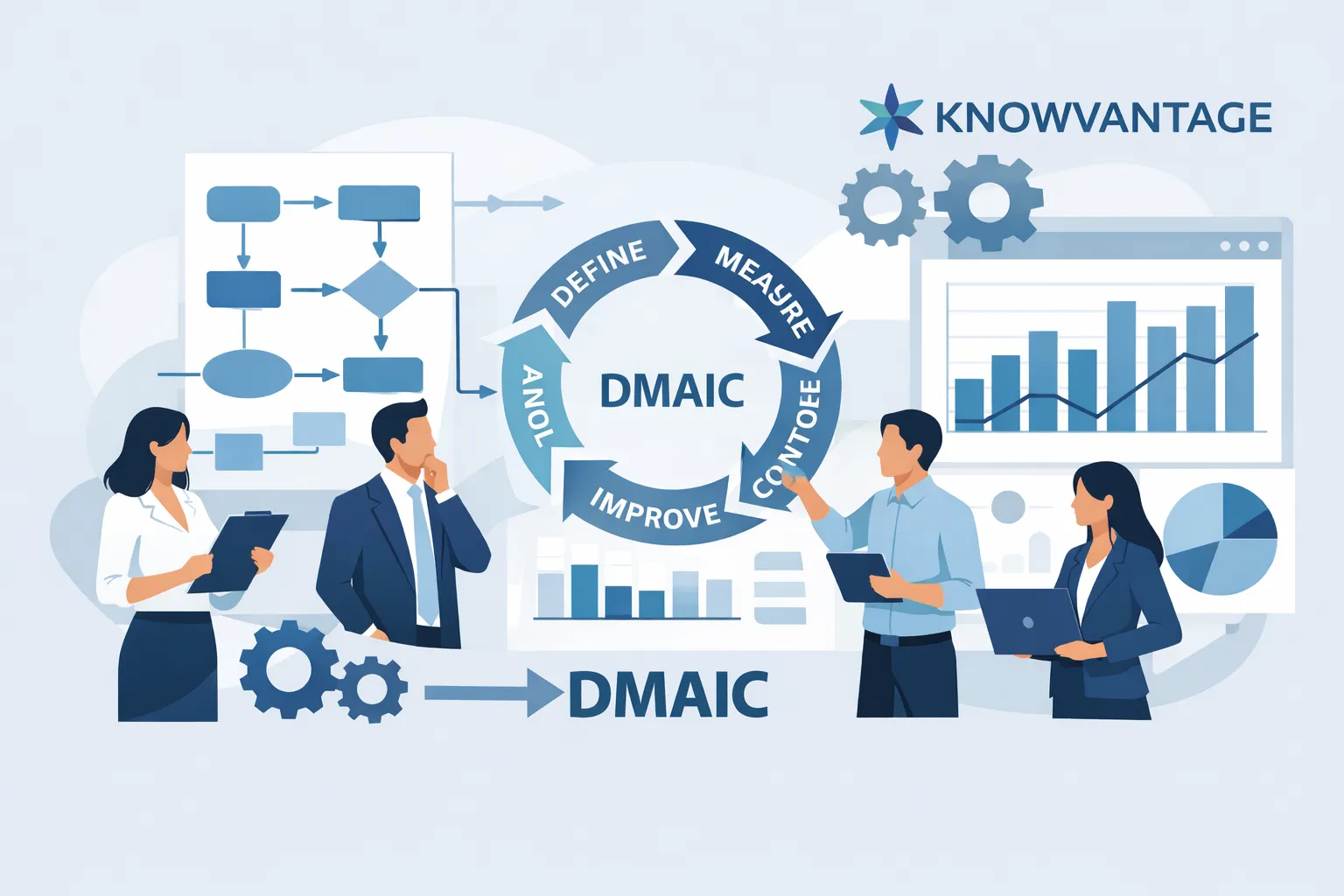




Reply to Comment