

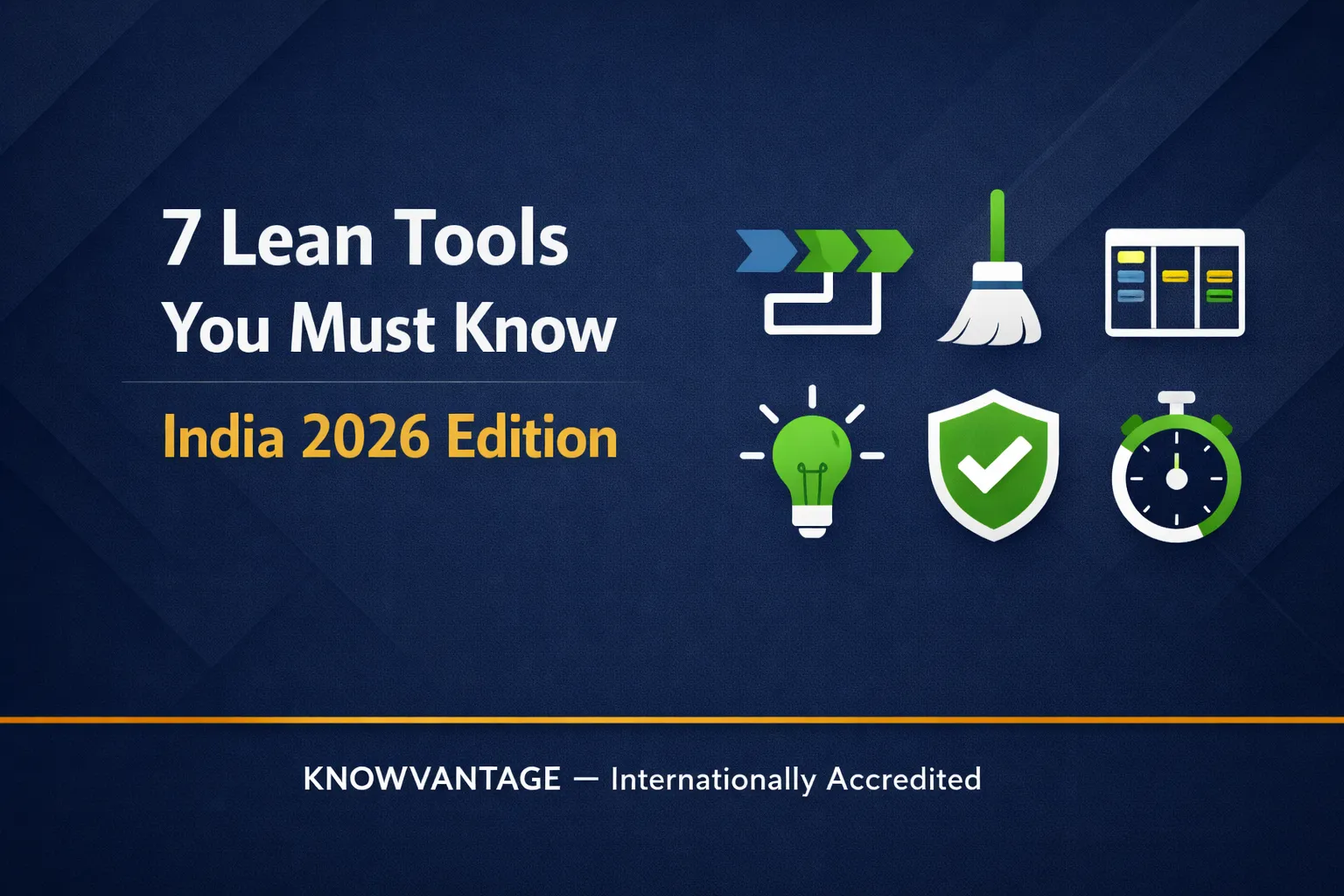

Lean Six Sigma has dozens of tools. Most professionals never need all of them. But there are 7 that appear in almost every successful improvement project in India — regardless of industry. Master these 7 and you can solve 80% of the process problems you will ever encounter.
Key Takeaways
- These 7 tools are used across manufacturing, IT, pharma, BFSI and healthcare in India
- Each tool solves a specific type of waste — knowing which tool fits which problem is the real skill
- You do not need to be certified to start using most of these tools tomorrow
- Green Belt training teaches you how to apply all 7 in a structured DMAIC project
- Indian companies using these tools consistently report 20-40% efficiency gains within 90 days of implementation
Why These 7 Tools Specifically
Lean thinking originated in the Toyota Production System in Japan and has been adapted across every industry worldwide. In India it gained serious traction in the early 2000s through automotive and pharma sectors and has since spread into IT, BFSI and healthcare.
Of all the Lean tools available these 7 are the most universally applicable, the most taught in Green Belt and Black Belt programs, and the most commonly expected by Indian hiring managers when they say they want someone with Lean Six Sigma experience.
They are not ranked by importance — they serve different purposes. Read through all 7 and identify which 2 or 3 apply most directly to your current role and industry. That is where you start.
Tool 1 — Value Stream Mapping (VSM)
Value Stream Mapping is a visual tool that maps every step in a process — from the moment a customer request arrives to the moment it is fulfilled. It shows the flow of both material and information, and crucially it shows where time is being lost, where inventory is piling up, and where the real waste lives.
How It Works
You draw a Current State Map showing the process exactly as it is today — every step, every wait time, every handoff, every inventory point. Then you draw a Future State Map showing how the process should flow with waste removed. The gap between the two maps is your improvement roadmap.
VSM uses specific icons for processes, inventory, push arrows, pull systems, and information flows. Once you learn the notation you can read any VSM anywhere in the world.
India Example
A Pune auto components manufacturer used VSM to map their engine bracket production line. The current state map revealed 14 process steps with a total value-added time of 23 minutes — but a total lead time of 4.5 days. Over 95% of the time the product was sitting waiting — not being worked on. The future state map eliminated 4 non-value-added steps and reduced lead time to 1.2 days, freeing Rs.35L in tied-up inventory.
Tool 2 — 5S Workplace Organisation
5S is a systematic method for organising the workplace so that everything needed is available, everything unneeded is removed, and the standard is maintained over time. It is often the first Lean tool implemented in any organisation because it creates the visual foundation for every other improvement.
The 5 Steps
Sort (Seiri): Remove everything from the workspace that is not needed for current work. Red-tag items that are questionable.
Set in Order (Seiton): Arrange what remains so that everything has a designated place and can be found within 30 seconds. A place for everything and everything in its place.
Shine (Seiso): Clean the workspace thoroughly and use the cleaning process as an inspection — dirt and damage become visible.
Standardise (Seiketsu): Document the standard so that anyone can maintain the organised state without being told how.
Sustain (Shitsuke): Build habits and audit processes that ensure the standard is maintained, not just achieved once.
India Example
A Chennai garment factory implemented 5S across their cutting and stitching floor. Sorting eliminated 3 trolleys of unused materials and tools that had accumulated over years. Setting in order reduced average tool retrieval time from 4.5 minutes to under 45 seconds. The combined effect was a 12% increase in output per shift with zero additional headcount or machinery investment.
Tool 3 — Kaizen (Continuous Improvement Events)
Kaizen is both a philosophy and a specific improvement event format. As a philosophy it means every person in the organisation is responsible for improving their own work — not just managers and engineers. As an event format a Kaizen blitz is an intensive 3-5 day focused improvement effort where a cross-functional team tackles one specific problem and implements the solution before dispersing.
How Kaizen Events Work in Practice
Day 1: Define the problem scope and measure the current state. Day 2-3: Analyze root causes and design solutions. Day 4: Implement changes in the actual workspace. Day 5: Measure results and standardise the improvement. The speed and intensity of a Kaizen event creates momentum that longer projects often lose.
India Example
A Hyderabad IT company ran a 4-day Kaizen event on their incident management process. The team — 6 people from IT operations, QA, and customer service — identified 8 non-value-added steps in the ticket resolution flow and eliminated 5 of them during the event itself. Average resolution time dropped from 4.2 hours to 1.8 hours. Total cost of the event: one facilitator and 4 days of team time. Annual saving in SLA penalty avoidance: Rs.18L.
Tool 4 — Kanban (Visual Pull System)
Kanban is a visual system that controls the flow of work by making work visible and limiting work-in-progress. In manufacturing it signals when to produce and when to replenish. In IT and service environments it is used to manage task flow, limit multitasking, and make bottlenecks immediately visible.
The Core Principle
In a traditional push system work is pushed forward whether the next step is ready or not — creating queues and waiting. In a Kanban pull system work only moves forward when the downstream step signals it is ready. This eliminates overproduction — the most wasteful of the 8 Lean wastes.
A physical Kanban board has three columns at minimum: To Do, In Progress, Done. The critical rule is a WIP limit — a maximum number of items allowed in the In Progress column at any time. When the column is full no new work starts until something is completed.
India Example
A Bengaluru software development team was struggling with context switching — developers working on 6-8 tasks simultaneously and finishing none of them on time. Implementing a Kanban board with a WIP limit of 2 per developer reduced average task completion time from 11 days to 4 days and improved sprint predictability from 54% to 87% within 6 weeks.
Tool 5 — Poka Yoke (Mistake Proofing)
Poka Yoke means mistake proofing in Japanese. It is the design of a process or product so that errors are impossible or immediately detectable. Rather than relying on people to be careful Poka Yoke builds the safeguard directly into the system.
Three Types of Poka Yoke
Prevention Poka Yoke: Makes the error physically impossible. A SIM card that can only be inserted in one orientation. A fuel nozzle shaped differently for petrol and diesel.
Detection Poka Yoke: Allows the error to occur but detects it immediately before it moves downstream. A barcode scanner that beeps if a wrong product is packed.
Warning Poka Yoke: Alerts the operator that conditions are approaching an error state. A machine that slows down automatically when temperature exceeds a threshold.
India Example
A Mumbai pharmaceutical packing line was experiencing label mix-ups — the wrong label being applied to the wrong product — at a rate of 0.3% which sounds small but represented 1,400 units per month being recalled or destroyed. A detection Poka Yoke using a vision system that verified barcode match before each label was applied reduced mix-ups to zero within the first month of implementation. Annual saving in waste and recall costs: Rs.42L.
Tool 6 — SMED (Single Minute Exchange of Die)
SMED is a technique for dramatically reducing the time it takes to switch a machine or process from producing one product to another. The name comes from manufacturing where changing the dies in a press machine used to take hours. SMED reduced this to single-digit minutes in many cases. The principle applies to any changeover — not just die pressing.
The SMED Method in 3 Steps
Step 1 — Separate Internal and External Activities: Internal activities can only be done when the machine is stopped. External activities can be done while the machine is still running. Most changeovers have 30-50% of activities that are unnecessarily internal.
Step 2 — Convert Internal to External: Move as many activities as possible to be done before the machine stops — pre-staging tools, pre-heating moulds, pre-assembling components.
Step 3 — Streamline All Remaining Activities: Standardise and simplify every remaining step. Use quick-release fasteners, standardised tool locations, and single-bolt connections.
India Example
An Ahmedabad plastics injection moulding plant had an average mould changeover time of 3 hours and 20 minutes. A SMED project over 8 weeks separated internal and external activities, pre-staged all tooling, and standardised the bolt sequence. New changeover time: 48 minutes — a 76% reduction. With 4 changeovers per shift this freed 10 additional production hours per day — equivalent to adding a part-shift without any new equipment.
Tool 7 — Visual Management
Visual Management is the practice of making the status of work, performance, problems, and standards immediately visible to anyone walking through the area — without needing to ask, read a report, or log into a system. If you need to ask how things are going, Visual Management is missing.
Visual Management in Practice
Production boards: Show actual vs planned output updated hourly. Any deviation is visible immediately and addressed in real time rather than discovered in next week's report.
Andon systems: Lights or signals that indicate machine status — green running normally, yellow attention needed, red line stopped. Anyone on the floor knows the status of every machine at a glance.
Floor markings: Coloured tape or paint that defines where materials, equipment, and people belong. Anything out of place is immediately obvious.
KPI dashboards: In IT and service environments — large visible screens showing live metrics like ticket queue depth, SLA compliance, and defect rates updated in real time.
India Example
A Delhi NCR BFSI operations centre implemented a Visual Management dashboard showing live loan processing queue, average handling time, and SLA compliance rate on screens visible to the entire floor. Within 3 weeks team leaders stopped relying on end-of-day reports to identify problems — issues were spotted and resolved within the same hour. SLA compliance improved from 81% to 94% with no change in headcount or process steps.
Quick Reference — All 7 Tools at a Glance
| Tool | What It Solves | Best Used In | Difficulty to Implement |
|---|---|---|---|
| Value Stream Mapping | Hidden waste and long lead times | Manufacturing, logistics, healthcare | Medium |
| 5S | Disorganised workplaces and wasted search time | All industries — ideal first tool | Low |
| Kaizen | Specific focused problems needing fast results | All industries | Low-Medium |
| Kanban | Overproduction and work-in-progress pile-up | Manufacturing, IT, service operations | Low |
| Poka Yoke | Recurring human errors and defects | Manufacturing, pharma, IT, BFSI | Medium |
| SMED | Long changeover and setup times | Manufacturing, food processing, packaging | Medium-High |
| Visual Management | Lack of real-time performance visibility | All industries | Low |
Where to Start — A Practical Guide for Indian Professionals
Do not try to implement all 7 tools at once. Pick one based on your biggest current pain point.
If your biggest problem is long lead times or slow processes: Start with Value Stream Mapping. Draw your current state this week. The waste will be immediately visible.
If your biggest problem is a disorganised workspace where people waste time looking for things: Start with 5S. You can run a Sort session this week with your team with zero budget and zero outside support.
If your biggest problem is a specific recurring defect or error: Start with Poka Yoke. Map where the error occurs and ask — how could we make this error impossible or immediately detectable?
If your biggest problem is too much work in progress and nothing getting finished: Start with Kanban. Draw a simple board, set a WIP limit of 3 per person, and see what happens in two weeks.
If you want to understand the full picture of your process before picking a tool: Green Belt certification trains you on all 7 tools with live project application — so you know not just what each tool is but exactly when and how to use it.
Frequently Asked Questions
Want to Apply These Tools in a Real Project?
Knowvantage's Green Belt program teaches all 7 tools with live expert mentoring and a real project — so you leave knowing exactly how to use each one, not just what it is called.
Book a Free ConsultationDownload Free Lean Tools Cheat Sheet



Reply to Comment